
How to make Modak without a mold – this question haunted me for three Ganesh Chaturthis. You know why? Because I bought two different modak molds. One plastic, one wooden. Both broke. The plastic one cracked in the middle of making the dough. The wooden one? It got stuck and I had to literally bang it on the counter. My modaks came out looking like sad, lumpy potatoes. My mother-in-law visited that year. She just looked at my modaks and said, “Beta, yeh kya hai?” I wanted to hide under the table.
But here is the thing. Our grandmothers never used molds. They used their hands. Their fingers. Their patience. And their modaks were perfect – soft, fragrant, with beautiful pleats like a tiny flower. The smell of fresh rice flour, jaggery, and cardamom would fill the entire house. And the texture? Melting in your mouth, soft yet firm enough to hold shape.
How to Make Modak without a mold
So I decided to learn the hand-shape method. I failed. A lot. The dough cracked. The filling leaked. The pleats disappeared when steaming. But finally – finally – I figured it out. And I am going to tell you exactly how to make Modak without a mold using nothing but your clean, slightly oily hands.
No special tools. No frustration. Just you, the dough, and a little bit of practice.
A small tangent before we start: My wife says I have fat fingers. That is true. If I can do it, anyone can. So relax. Even if your first modak looks like a squashed ball, Ganpati Bappa will still love it. But let us try to make it pretty anyway.
Step-by-Step Recipe Method
1st Step: Roast the Filling (Saran)
Take a small kadhai. Heat 1 teaspoon ghee on low flame. Add the fresh grated coconut. Roast for 2 to 3 minutes until the raw smell goes away and the coconut turns slightly dry. Do not brown it. Add the grated jaggery. Stir continuously. The jaggery will melt and become liquid. Keep stirring for 4 to 5 minutes. The mixture will start leaving the sides of the pan. That is the right consistency.
Add cardamom powder, nutmeg (if using), and chopped nuts. Mix. Turn off the flame. Let the filling cool completely. It should be dry enough to roll into small balls. If it is too sticky, roast for another minute. If too dry, add a teaspoon of warm milk.
A mistake I made: I did not let the filling cool. I tried to stuff hot filling into the dough. The dough melted and tore. So wait. Patience.
2nd Step: Make the Rice Flour Dough (Ukad)
Boil 1 cup of water in a deep pan. Add ½ teaspoon ghee and a pinch of salt (if using). When the water comes to a rolling boil, reduce the flame to low. Add the rice flour all at once. Stir quickly with a wooden spoon. Keep stirring for 1 to 2 minutes until the mixture comes together like a soft dough. No dry flour should remain.
Turn off the flame. Cover and let it sit for 5 minutes. This step is important – it lets the flour absorb the water completely.
3rd Step: Knead the Dough While Warm
After 5 minutes, transfer the dough to a plate. Let it cool until you can touch it comfortably but it is still warm. Grease your palms with a little ghee. Knead the dough for 3 to 4 minutes until it becomes smooth and elastic. If it feels sticky, add a little more rice flour. If it feels dry, sprinkle a few drops of warm water. The dough should be soft, like play-dough.
Do not let the dough cool completely. Cold rice flour dough cracks terribly. I learned this after making 20 cracked modaks in one evening.
4th Step: Roll Filling Balls
While the dough is resting, take the cooled coconut filling. Make small balls – about the size of a large marble or a small lemon (depending on how big you want your modak). I make about 12 to 15 balls from this quantity. Keep aside.
5th Step: Prepare the Dough Balls
Divide the dough into equal portions – same number as the filling balls. Each dough ball should be slightly larger than the filling ball. Roll each dough ball into a smooth sphere. Keep them covered with a wet cloth so they do not dry out.
6th Step: Shape the Modak – The Hand Method
This is the main event. Take one dough ball. Press it flat between your palms to make a small disc. Now, use your thumb and index finger to gently press the edges, rotating the disc like a small bowl. The centre should be thicker, the edges thinner. Aim for a 2 to 3 inch circle.
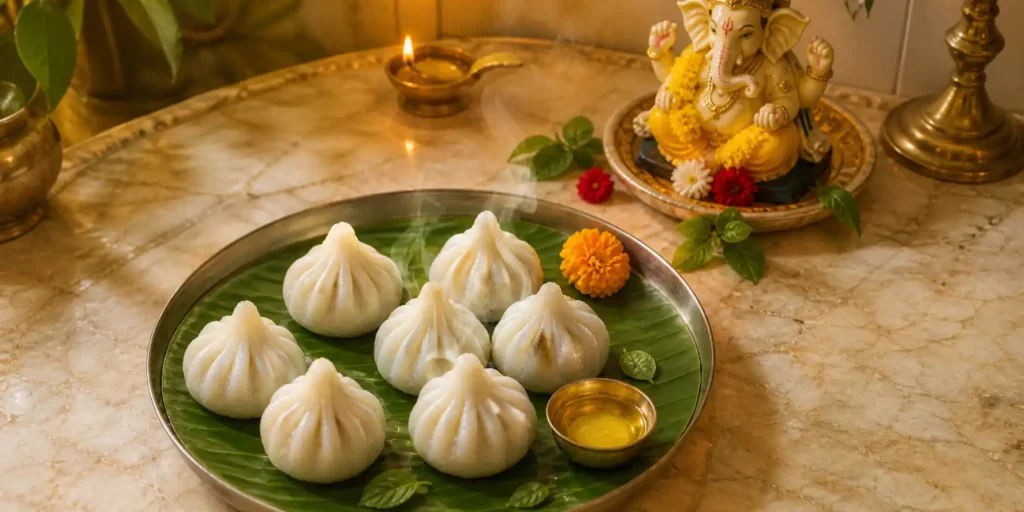
Place one coconut filling ball in the centre. Now, bring the edges together. Pinch the edges to form pleats – like little folds. Start from one side and go around. Press all the pleats together at the top to seal. The top should look like a small peak. Do not leave any gap – otherwise the filling will come out during steaming.
If you cannot make pleats, do not worry. Simply bring the edges together and pinch to seal. Then gently shape it like a teardrop. That is called a “sweet dumpling” and Ganpati will not mind at all.
A personal disaster: On my first attempt, I made 5 pleats on one side and none on the other. It looked like a crooked hat. Still tasted good.
7th Step: Steam the Modaks
Grease a steamer plate or idli stand with ghee. Place the shaped modaks leaving space between them – they expand a little. Heat water in a steamer or a large pot with a lid. When steam starts rising, place the plate inside. Cover and steam on medium flame for 10 to 12 minutes.
Do not open the lid in between. I opened once to “check” and all the steam escaped. The modaks became hard and dry. So resist the temptation.
8th Step: Check and Serve
After 12 minutes, turn off the flame. Open the lid carefully. The modaks should look glossy, slightly translucent, and firm to touch. Insert a toothpick – it should come out clean. Remove the modaks with a spatula. Let them cool for 2 minutes. Then transfer to a serving plate. Brush with a little warm ghee for shine.
Serve hot or warm. Cold modaks become hard.
Pro Cooking Tips
-
Mistake to avoid: Using boiling water while kneading. Let the dough cool until you can handle it, but not until it is cold. Warm dough is flexible. Cold dough is a cracker.
-
Cracking solution: If your dough cracks while shaping, your hands are dry. Grease them again with ghee. Also add 1 teaspoon of hot water to the dough and knead again.
-
Filling texture: The coconut-jaggery filling should be dry enough to hold shape. If it is too wet, it will make the dough soggy. If too dry, it will crumble. Aim for a soft, fudge-like consistency.
-
Steaming hack: If you do not have a steamer, take a large pot. Add 2 inches of water. Place a steel strainer or a perforated plate inside. Cover with a tight lid. Works perfectly.
-
Leftover modaks: Store in an airtight container in the fridge for 2 days. Reheat by steaming for 5 minutes – never microwave. Microwaved modaks become rubbery.
-
Practice pleats: Do not expect perfect pleats on the first modak. Make 2 or 3 practice ones. The dough is forgiving. You can re-roll and try again.
Variations & Substitutes
Healthy version: Replace jaggery with dates paste (mash 5-6 dates with 2 tablespoons warm water). Use brown rice flour instead of white rice flour. Add flaxseed powder to the dough.
Jain version: No potatoes or root vegetables? This recipe has none. But Jains avoid jaggery that may be processed with bone charcoal. Use organic jaggery or palm sugar. No nutmeg (some Jains avoid). All good.
Without onion-garlic: Already without onion, garlic, ginger. Completely saatvik.
Vegan version: Replace ghee with coconut oil in dough, filling, and for greasing. Works beautifully. The coconut flavour actually complements the modak.
Sugar-free version: Use stevia powder mixed with a little coconut milk. Not traditional, but diabetic-friendly.
Serving Suggestions
Serve these handmade modaks as naivedya (bhog) to Lord Ganesha. Place them on a banana leaf or a clean brass plate. Offer a small bowl of ghee and a few tulsi leaves alongside. After the aarti, eat them as prasad along with a glass of warm milk or curd.
Best time to enjoy? Ganesh Chaturthi festival, of course. But also on any day you want a sweet, comforting, steamed dumpling. They are much lighter than fried sweets and do not give that heavy feeling.
For a complete Ganesh Chaturthi thali, pair these modaks with karanji (another sweet) and sabudana vada. And if you want to explore more traditional festival recipes, check out my Janmashtami Bhog Thali on Luckky Corner – it has similar saatvik principles. Also try my Foxtail Millet Khichdi for a healthy everyday meal.
FAQs
Is it really possible to make modak without a mold?
Absolutely. This hand-shaping method is older than any mold. Indian grandmothers have been doing it for centuries. It just needs a little practice and the right dough consistency.
Why does my rice flour dough crack when I try to shape it?
Two reasons. Either the dough is too dry (add a few drops of warm water and knead again) or it has become cold (warm it slightly with your hands or keep it covered with a damp cloth).
Can I use regular rice flour from the store?
Yes, but make sure it is fine and not coarse. Coarse rice flour will not hold shape. If you have only coarse flour, grind it once more in a mixer grinder. Some people use idiyappam flour (string hopper flour) – that works perfectly.
How do I get perfect pleats without a mold?
Practice. Keep your fingers lightly greased with ghee. Pinch and pull the dough edge slightly while folding. The dough should be soft but not sticky. Watch a video if needed – but honestly, even imperfect pleats taste the same.
How long can I store modaks?
Fresh modaks are best eaten within 24 hours. Refrigerate in an airtight container for up to 2 days. To reheat, steam for 5 minutes. Do not freeze – the texture becomes grainy.
What is the difference between ukdiche modak and fried modak?
Ukdiche modak are steamed (the recipe above). Fried modak are deep-fried in ghee or oil. Steamed are softer, healthier, and traditionally offered to Ganesha. Fried are more for snacking.
Conclusion
Learning how to make Modak without a mold changed my Ganesh Chaturthi forever. No more broken molds, no more last-minute runs to the store. Just my hands, some rice flour, and a whole lot of love. The first few modaks might look funny. That is fine. Bappa has a sense of humour. By the fifth modak, your fingers will remember the movement. By the tenth, you will feel like a pro.
Try this method this Ganesh Chaturthi. Make a small batch. Serve them hot with ghee. Then come back here and tell me – did your modaks look like actual modaks or like little aliens? Either way, I want to hear. And if you managed perfect pleats on the first try, I will be slightly jealous but very proud.
Ganpati Bappa Morya.