
Difference between Charnamrit and Panchamrit – honestly, for the longest time, I thought they were the same thing. You know, both are offered to gods, both have milk and curd, both taste sweet and cooling. I would go to the temple, see the priest giving out something in a small bowl, and just assume it was all the same. But one day, my wife – she is the organized one – asked me to bring charnamrit for a small puja at home. I brought panchamrit. She gave me that look. You know the look.
So I sat down. I asked my aunt. I called my mother. I even looked up old scriptures – well, I tried. It turns out, the difference is very clear once you know it. Charnamrit is simpler, made with just a few ingredients, and it is specifically the liquid used to bathe the deity’s feet (hence “charan” meaning feet). Panchamrit is richer, has five ingredients (“panch” means five), and is used for abhishekam (bathing the idol) on special occasions like festivals.
Difference between Charnamrit and Panchamrit
Let me share what I learned. I will also give you simple recipes for both, so you can make them at home. And I promise – next time your wife asks for one, you will not bring the other.
A small tangent: I once added honey to charnamrit because I forgot which was which. The priest did not say anything, but I saw him raise an eyebrow. So let us fix this confusion once and for all.
Step-by-Step Recipe Method
1st Step: Make Charnamrit (The Quick One)
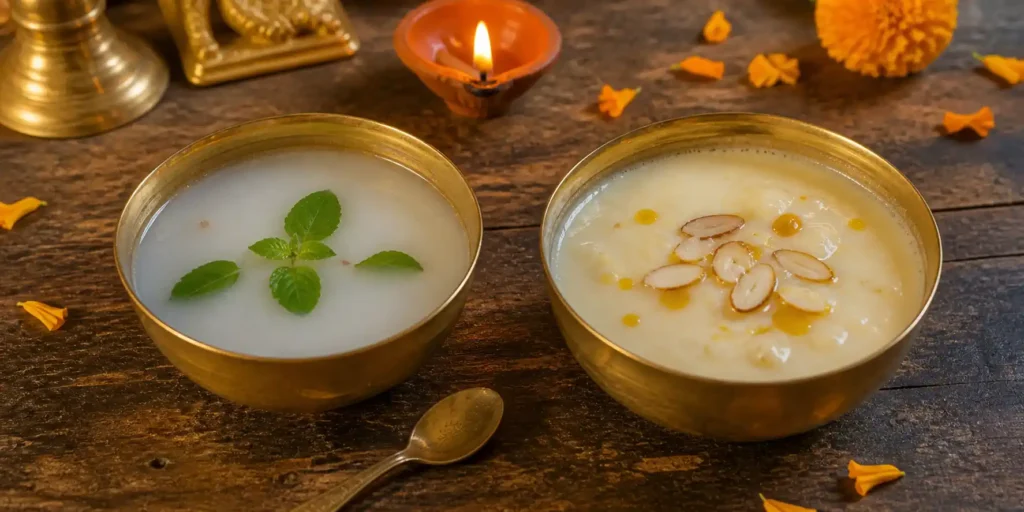
Take a clean bowl – preferably brass or silver, but steel is fine. Add the fresh curd. Whisk it gently with a spoon until it becomes smooth and lump-free. Add cold water. Mix well. The consistency should be like thin buttermilk – not too watery, not too thick. Add sugar and stir until dissolved. Drop a few tulsi leaves on top. Sprinkle cardamom powder if using. That is it. No cooking. No heating. Ready in 2 minutes.
A mistake I made: I once used hot water. The curd curdled immediately. Never again. Always cold or room temperature water.
2nd Step: Offer Charnamrit
Charnamrit is offered to the deity after the main abhishekam. It is traditionally the liquid used to wash the feet of the idol. In many temples, it is distributed as prasad. You can also keep it in a small bowl near the deity during daily puja.
3rd Step: Make Panchamrit (The Festive Five)
Take another clean bowl. Add the curd – whisk until smooth. Add raw milk. Stir gently. Now add ghee. The ghee might float a little – that is fine. Add honey. Stir again. Finally, add sugar. Mix everything until the sugar dissolves fully. The colour should be a pale creamy yellow. The texture will be slightly thicker than charnamrit because of the ghee and honey. If you want, add a pinch of cardamom powder or a few sliced almonds for garnish. Some people add a drop of gangajal for sanctity.
4th Step: Understand the Consistency Difference
Charnamrit is thin – you can drink it easily. Panchamrit is slightly thicker and richer – you often eat it with a spoon, though it is still pourable. Do not make panchamrit too thick; it should still flow like a thick lassi.
5th Step: When to Use Which?
Use charnamrit for:
-
Daily puja at home
-
Simple offerings on ordinary days
-
After bathing the deity’s feet
-
As a light, cooling prasad
Use panchamrit for:
-
Festival days (Janmashtami, Shivaratri, Ganesh Chaturthi)
-
Abhishekam (ritual bathing of the idol)
-
Special occasions like weddings or housewarming
-
When you want to make a richer offering
6th Step: Storage and Shelf Life
Both are fresh dairy products. Do not store them for more than a few hours. Charnamrit, because of the water, spoils faster – consume within 4 hours. Panchamrit, with honey and ghee, can last up to 8 hours in the fridge. But honestly? Make fresh. Offer fresh. That is the whole point.
I once kept panchamrit in the fridge overnight. It separated into layers. The honey settled at the bottom. Not a good look.
7th Step: A Note on Ratios (For Perfectionists)
For charnamrit, the ratio is roughly 2 parts curd to 1 part water. But adjust to your preference. Thicker is fine too. For panchamrit, use equal parts of all five ingredients – curd, milk, ghee, honey, sugar. That is the traditional proportion. But many families adjust the sweetness. Do what feels right.
8th Step: Serving as Prasad
After offering, pour a small amount into each devotee’s cupped hand or a small bowl. Charnamrit is usually drunk. Panchamrit can be drunk or eaten with a spoon. Some temples mix both and give as prasad. That is called “charnamrit-panchamrit mishran”. But now I am getting too academic. Let me stop.
Pro Cooking Tips
-
Mistake to avoid: Using sour curd for panchamrit. Panchamrit should taste sweet and rich. Sour curd ruins the flavour. For charnamrit, a little sourness is acceptable – even good – because it is cooling.
-
Temperature alert: Never use hot or even warm milk in panchamrit. Warm milk will curdle the curd. Use chilled or room temperature ingredients.
-
Ghee quality: For panchamrit, use good quality desi ghee. Cheap ghee has an artificial smell that will overpower everything.
-
Honey tip: If your honey is crystallized, warm the jar in a bowl of hot water (not microwave) until it becomes liquid again. Solid honey does not mix well.
-
Tulsi leaves: Always add fresh tulsi leaves, not dried. Dried tulsi has a different energy and is not used in charnamrit traditionally.
-
Gangajal option: A single drop of gangajal (holy water from Ganga) is sometimes added to both. Do not add more – it is symbolic, not a flavour ingredient.
Variations & Substitutes
Healthy version (low sugar): Use jaggery powder instead of sugar in both. Reduce quantity by half. For panchamrit, use raw honey only (not processed). Add a pinch of cinnamon for blood sugar balance.
Jain version: No honey. For panchamrit, replace honey with an equal amount of jaggery or date syrup. Also, some Jains avoid raw milk – boil and cool it first. Use only boiled milk.
Without onion-garlic: Both are already without onion and garlic. They are saatvik by definition.
Vegan version: Replace curd with coconut curd (coconut yogurt). Replace milk with coconut milk (thin version). Replace ghee with coconut oil. Replace honey with maple syrup. The taste will be coconut-forward but still delicious.
Sugar-free version: Use stevia powder or monk fruit sweetener. For honey, use sugar-free maple syrup. Not traditional, but diabetic-friendly.
Serving Suggestions
Both charnamrit and panchamrit are not “served with” anything else. They are prasad – offered to the deity first, then consumed by devotees. However, after drinking charnamrit, it is common to eat a small piece of fruit or a few roasted chana. And after panchamrit, many families give a small piece of modak or karanji (sweet) because panchamrit is usually part of a festive thali.
Best time to prepare? For charnamrit, any morning during daily puja. For panchamrit, on festival days or special occasions like Janmashtami, Ganesh Chaturthi, or when you have guests for a puja at home.
If you are planning a festive thali, check out my Ganesh Chaturthi Recipes post on Luckky Corner – it includes modak and karanji that pair beautifully with panchamrit. Also, for a deeper understanding of saatvik offerings, read my Traditional Sattvic Recipes for Energy – the principles are similar.
FAQs
What is the main difference between charnamrit and panchamrit?
The main difference is the number of ingredients and the purpose. Charnamrit has 2-4 ingredients (curd, water, sugar, tulsi) and is used to bathe the deity’s feet. Panchamrit has 5 ingredients (curd, milk, ghee, honey, sugar) and is used for full abhishekam on festivals.
Can I use charnamrit instead of panchamrit?
For daily puja, yes. For special festivals, no. Panchamrit is considered more sacred and richer. Using charnamrit on a festival day is not wrong, but it is not traditional.
Why is honey added only to panchamrit?
Honey is one of the five “nectars” (amrits) in Hindu rituals. The five are milk, curd, ghee, honey, and sugar. Charnamrit is simpler and does not require all five. Some scriptures say honey represents the sweetness of devotion.
Is it okay to drink leftover charnamrit or panchamrit after offering?
Yes, absolutely. Whatever is offered to the deity becomes prasad. It is considered blessed and can be consumed by family members. Do not throw it away.
Can I make both without sugar?
You can use jaggery or dates paste. However, traditional recipes use sugar or mishri (sugar crystals). For health reasons, you can reduce the quantity or substitute, but the taste will change.
Why does my panchamrit sometimes become watery?
You may have used too much milk, or your curd was too thin. Use thick, fresh curd and full-fat milk. Also, add ghee at the end – it helps stabilize the emulsion.
Conclusion
So, the difference between charnamrit and panchamrit is not complicated once you remember two things: charnamrit is for the feet (simple, daily), panchamrit is for the whole deity (five ingredients, festive). Both are beautiful offerings. Both taste like heaven on a hot day. And both are easy to make – you really have no excuse to buy the packaged stuff from the store.
Next time you need to make prasad, just look at your calendar. Ordinary Tuesday? Charnamrit. Ganesh Chaturthi? Panchamrit. And if you still mix them up, do not worry. The gods have a sense of humour. I know because I have tested it many times.
Try making both this weekend. Taste them side by side. Then come back and tell me – did you finally remember which is which? Or did you add honey to charnamrit like I did? The comments section is waiting for your confessions.