
Ganesh chaturthi recipes – just hearing those words makes my stomach rumble. You know, Bappa loves his food. Especially sweets. Especially modak. The smell of fresh coconut and cardamom roasting in ghee, the sight of steam rising from the pressure cooker carrying those little white dumplings, and the sound of the aarti bell – it all comes together like a perfect festive symphony. I remember one year, my mother made 56 modaks. Fifty-six. Our kitchen looked like a coconut battlefield. But when Bappa arrived, that thali was a thing of beauty. Golden, white, crispy, soft – every texture.
So here is the thing. I am not a master chef. I am the guy who forgets to buy rice flour and then makes a midnight run to the kirana store. But over the years, I have collected a few ganesh chaturthi recipes that are foolproof. Or at least, idiot-proof. I tested them. I failed. I succeeded. Now I am sharing them with you.
Ganesh Chaturthi Recipes
A small tangent before we dive in. One year, I tried to make everything from scratch – modak, karanji, laddoo, peda, everything. I ended up crying in the kitchen at 2 AM. Do not be me. Pick two or three items. Make them with love. Bappa will be happy. I promise.
Today, I am sharing four classic naivedya recipes:
-
Ukdiche Modak (steamed rice dumplings with coconut jaggery filling)
-
Karanji (crispy fried pastry with same filling)
-
Sabudana Vada (tapioca pearl fritters – for that salty balance)
-
Puran Poli (sweet flatbread – optional but festive)
We will focus on the modak in the step-by-step method, because modak is the king of Ganesh Chaturthi. The others will have quick instructions.
Step-by-Step Recipe Method (Focus on Ukdiche Modak)
1st Step: Make the Coconut Filling (Saran)
Take a kadhai. Heat 1 teaspoon ghee on low flame. Add fresh grated coconut. Roast for 2 to 3 minutes until the raw smell goes away. Add grated jaggery. Stir continuously. The jaggery will melt. Keep stirring for 4 to 5 minutes until the mixture starts leaving the sides of the pan. Add cardamom powder and nuts. Mix. Turn off flame. Let the filling cool completely. Roll into small equal-sized balls. Keep aside.
A mistake I made: I did not let the filling cool. The hot filling melted the dough. Disaster.
2nd Step: Prepare the Rice Flour Dough (Ukad)
Boil 1 cup of water in a pan. Add ½ teaspoon ghee. When water boils vigorously, reduce flame to low. Add rice flour all at once. Stir quickly with a wooden spoon. Keep stirring for 1 to 2 minutes until the dough comes together. No dry flour should remain. Cover and let it sit for 5 minutes.
3rd Step: Knead the Dough
Transfer the dough to a plate. Let it cool until you can touch it but it is still warm. Grease your palms with ghee. Knead for 3 to 4 minutes until smooth and elastic. If sticky, add a little rice flour. If dry, sprinkle warm water. Keep the dough covered with a wet cloth.
Do not let it cool completely. Cold dough cracks. I learned this after 15 cracked modaks.
4th Step: Shape the Modak
Take a small dough ball. Press it flat into a disc. Use your thumb and index finger to press the edges, making a small bowl shape (centre thick, edges thin). Place a coconut filling ball inside. Bring the edges together. Pinch to form pleats – small folds. Press all pleats together at the top to seal. No gaps allowed. Repeat for all modaks.
If pleats are too hard, just pinch and seal into a teardrop shape. Bappa does not judge.
5th Step: Steam the Modaks
Grease a steamer plate or idli stand with ghee. Place modaks leaving space between them. Heat water in a steamer or large pot with lid. When steam rises, place the plate inside. Cover and steam on medium flame for 10 to 12 minutes. Do not open the lid in between. After 12 minutes, check – modaks should look glossy and firm. Remove with a spatula.
Quick Method for Karanji
Make a dough with maida, ghee, and warm water. Roll into small circles. Place the same coconut filling in the centre. Fold into half-moon shape. Press edges with fork to seal. Deep fry in ghee or oil on medium flame until golden brown. Drain. Crispy karanji is ready.
Quick Method for Sabudana Vada
Drain soaked sabudana completely. Mix with mashed potatoes, peanut powder, green chilli, cumin seeds, and salt. Make flat tikkis. Shallow fry on a tawa with oil or ghee until golden and crispy. Serve hot.
Quick Method for Puran Poli
Boil soaked chana dal until soft. Drain and mash. In a pan, cook mashed dal with jaggery and cardamom powder until dry. Make small balls. Roll wheat flour dough into discs, place filling inside, seal, and roll gently into a flatbread. Roast on tawa with ghee until golden spots appear.
Pro Cooking Tips
-
Mistake to avoid: Using cold water for rice flour dough. Always use boiling water. The starch needs to gelatinize for a smooth dough.
-
Filling texture tip: The coconut-jaggery mixture should be dry enough to roll into a ball. If it is too wet, the modak will become soggy from inside.
-
Sabudana trick: After soaking sabudana, spread on a cloth for 15 minutes to remove excess moisture. Less moisture = crispier vada.
-
Karanji storage: Store karanji in an airtight container for up to 2 weeks. They stay crispy. Modak? Eat fresh within a day.
-
Steaming without steamer: Use a large pot with a steel strainer or a perforated plate. Cover tightly. Works perfectly.
-
Timing for festival: Make the filling and dough one day before. Shape and steam on the day of bhog. Saves time and stress.
Variations & Substitutes
Healthy version: Use brown rice flour for modak. Replace jaggery with dates paste. For vada, air fry instead of shallow frying. For karanji, bake at 180°C for 15 minutes.
Jain version: All these recipes have no onion, no garlic, no ginger, no potato (in modak). For sabudana vada, the potato is a problem for strict Jains. Replace potato with raw banana or sweet potato. Use sendha namak (rock salt).
Without onion-garlic: Already without. These are saatvik festival recipes.
Vegan version: Replace ghee with coconut oil in all recipes. For puran poli, use oil instead of ghee while roasting. The taste will be slightly different but still delicious.
Sugar-free version: Use stevia or erythritol for filling. Not traditional, but diabetic-friendly.
Serving Suggestions
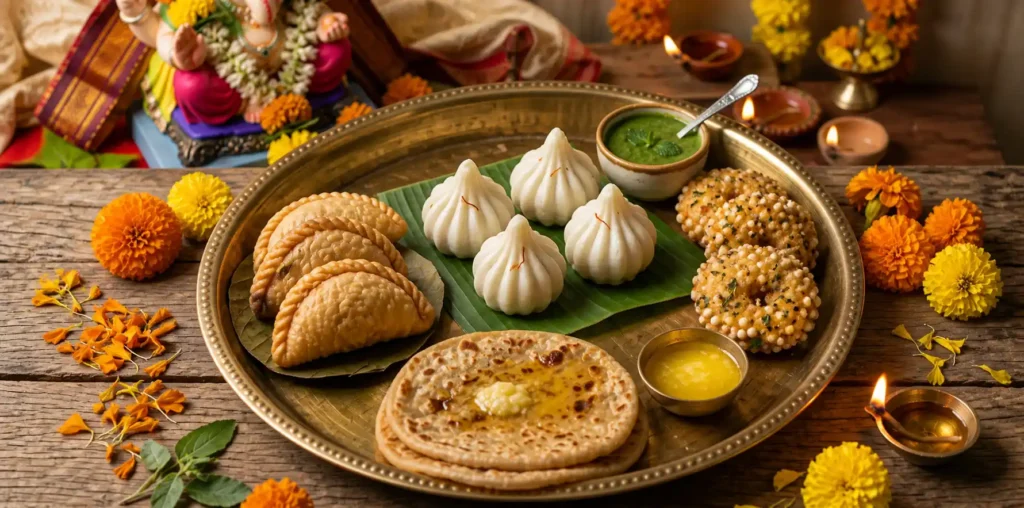
Arrange all these ganesh chaturthi recipes on a large brass or steel thali. Place the modak in the centre (Bappa’s favourite). Surround with karanji, sabudana vada, and puran poli. Add a small bowl of ghee for drizzling. Offer with a lit diya, some durva grass, and fresh marigold flowers.
Best time to serve? As naivedya during the aarti – morning, afternoon, or evening. After offering, enjoy as prasad with your family. Sabudana vada pairs beautifully with fresh coconut chutney or curd. Modak is perfect on its own.
For a complete festive meal, serve these alongside Janmashtami Bhog Thali items from Luckky Corner – many overlap in ingredients. And if you want to master just the modak, check out my detailed post on How to Make Modak Without a Mold – it is a lifesaver.
FAQs
What is the most important ganesh chaturthi recipe?
Modak is the most important because it is Lord Ganesha’s favourite sweet. Legend says that a sage created modak to please Ganesha. No Ganesh Chaturthi celebration is complete without modak.
Can I make modak without a steamer?
Yes. Use a large pot with a tight lid. Add 2 inches of water. Place a steel strainer or a perforated plate inside. Make sure the water does not touch the plate. Cover and steam. Works perfectly.
How many items are typically in a Ganesh Chaturthi thali?
Traditionally, 21 or 56 items (chappan bhog) are offered in temples. At home, 3 to 5 items are enough. Focus on quality and devotion, not quantity.
Can I freeze modak or karanji?
Modak does not freeze well – the texture becomes grainy. Karanji can be frozen after frying, but best eaten fresh. You can freeze uncooked karanji (shaped but not fried) for up to 1 month. Fry directly from frozen.
Is sabudana vada allowed for fasting (vrat)?
Yes, sabudana is a fasting staple. But during Ganesh Chaturthi, there is no fasting requirement unless you are doing a specific vrat. Sabudana vada is served as a savoury snack in the thali.
Why are these recipes made without onion and garlic?
Ganesh Chaturthi naivedya is saatvik (pure) food. Onion and garlic are considered tamasic (dulling to the mind) and are avoided in offerings to deities. The food should be light and sattvic.
Conclusion
These ganesh chaturthi recipes are my festival survival kit. The modak is soft and sweet, the karanji is crispy and addictive, the sabudana vada is crunchy and salty, and the puran poli is rich and comforting. Together, they make a thali that would make any Bappa smile.
Do not stress about perfection. My first modak looked like a squashed lemon. My first karanji leaked filling all over the oil. But Bappa still came home, and we still had a beautiful celebration. So make what you can. Make it with love. And then come back here to tell me – which recipe did your family fight over? For us, it is always the modak. Always.
Ganpati Bappa Morya.