
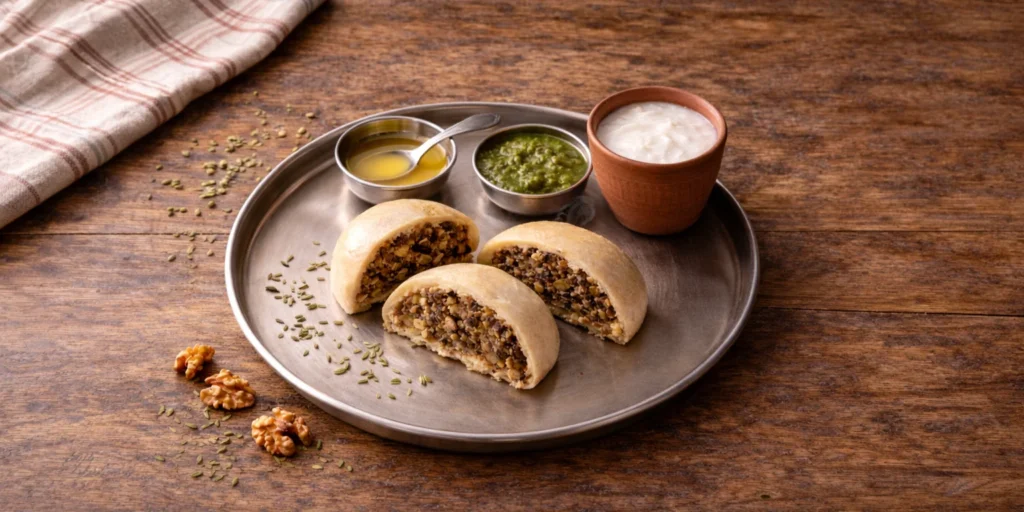
Himachali siddu – just saying the name makes me smile. You know why? Because the first time I tried to make it, my dumplings came out looking like flat stones. Hard. Dense. My dog took one sniff and walked away. But when you get it right? Oh, it’s magic. The smell of freshly steamed dough mixed with walnut and fennel fills your kitchen like a warm Pahadi hug. The texture is soft, almost like a cloud – but a cloud that actually fills your stomach.
I discovered this dish during a rainy trip to Manali. A local dadi served it with ghee and green chutney. I ate three. Then four. I felt like a stuffed teddy bear. Back in my Delhi kitchen, I kept failing. But after many sad, rubbery siddu experiments, I finally cracked the code. Now? This is my go-to comfort food for lazy Sundays. It is healthy, steamed (not fried), and packed with Himalayan flavours. Perfect for when you want something different from roti-paratha.
Let me save you from my mistakes.

Ingredients
For the Dough (the outer blanket)
- 2 cups whole wheat flour (gehu ka atta) – not the fine one, use the slightly coarse one
- 1 teaspoon active dry yeast or ½ teaspoon baking soda (I use yeast, feels more authentic)
- 1 tablespoon oil or melted ghee
- ½ teaspoon salt
- Warm water as needed – about ¾ cup, but do not pour all at once
For the Filling (the heart of the siddu)
- ½ cup walnuts (akhrot) – crushed into small pieces, not powder
- 1 tablespoon fennel seeds (saunf) – slightly crushed
- 1 inch fresh ginger (adrak) – finely grated
- 1 green chilli – chopped super fine (skip for kids)
- 2 tablespoons fresh coriander leaves (dhania)
- Salt to taste
- 1 teaspoon poppy seeds (khus khus) – optional but recommended
Alternatives
- No yeast? Use ½ teaspoon baking soda + 1 teaspoon lemon juice. The texture will be slightly different – more like a dhokla than a bun.
- No walnuts? Use peanuts or roasted chana. Taste changes but still yum.
- No fresh ginger? Use ½ teaspoon dry ginger powder (saunth). It gives a different warmth.

Step-by-Step Recipe Method
1st Step: Activate the Yeast
Take ¼ cup warm water (not hot – if you put your finger in, it should feel like bath water). Add the yeast and 1 teaspoon sugar. Stir gently. Wait for 10 minutes. You will see foam on top. That means the yeast is alive. If you see no foam, your yeast is dead. Throw it away and start again. I once used dead yeast and my siddu turned into hockey pucks.
2nd Step: Make the Dough
In a big bowl, take the wheat flour and salt. Add the oil or ghee. Rub it into the flour with your fingers – it should look like breadcrumbs. Now pour the foamy yeast water. Add more warm water little by little. Knead for 8 to 10 minutes. The dough should be soft and smooth, like a baby’s cheek. Not sticky. Cover with a wet cloth. Keep in a warm place for 1 hour.
While the dough is resting, let me tell you something. I usually forget to set a timer. So I put the dough near the geyser. It works perfectly. Just saying.
3rd Step: Prepare the Filling
Take a small bowl. Add crushed walnuts, fennel seeds, grated ginger, green chilli, coriander, and salt. Mix with your fingers. The smell at this point is intoxicating – fennel and ginger together remind me of those old Pahadi medicine shops. Keep aside.
4th Step: Shape the Siddu
After one hour, your dough would have doubled in size. Punch it down gently. Make 6 to 8 equal balls. Take one ball. Flatten it with your palm. Place 1 tablespoon of filling in the centre. Now bring the edges together – like you are making a poori but closing it from the top. Pinch to seal. No filling should come out. Gently roll it into a smooth ball again.
A small mistake I made: I over-stuffed. The siddu burst open while steaming. It looked like a volcano eruption. So do not be greedy.
5th Step: Steam the Siddu
You need a steamer. An idli cooker works best. Or take a big pot, add 2 cups water, place a steel strainer inside, and cover with a lid. Grease the steaming plate with a little oil. Place the siddu balls leaving space between them – they grow in size. Steam on medium flame for 15 to 18 minutes.
Do not open the lid in between. I repeat. Do not open. I opened once to “check” and all the steam escaped. The siddu became chewy. Patience, my friend.
6th Step: Check for Doneness
After 18 minutes, insert a toothpick or knife into a siddu. If it comes out clean, it is done. The colour will turn from pale brown to a nice golden. The surface will look shiny. Take them out carefully – they are hot. Let them rest for 2 minutes.
7th Step: The Butter or Ghee Touch
This is not a step, but a ritual. Cut the siddu in half. Put a generous dollop of ghee or butter inside. The heat melts it immediately. The ghee soaks into the soft layers. Now close it back and press lightly.
8th Step: Serve Hot
Arrange on a plate. Drizzle more ghee on top. Serve with coriander chutney or tamatar ki chutney. Or just eat plain. No judgement.
Pro Cooking Tips
-
Mistake to avoid: Do not use cold water for the dough. It kills the yeast. Use lukewarm water only. Your finger should feel comfortable.
-
Texture hack: If you want extra soft siddu, add 1 tablespoon of curd (dahi) while kneading. The lactic acid makes the dough tender.
-
Storage tip: Leftover steamed siddu can be refrigerated for 2 days. To reheat, steam again for 5 minutes. Never microwave – it turns rubbery.
-
Flavour booster: Add a pinch of hing (asafoetida) to the filling. It gives a very subtle earthy note that works beautifully with walnuts.
-
Water ratio: In the steamer, do not let the water touch the siddu. Keep at least 1 inch gap. Otherwise the bottom becomes soggy.
Variations & Substitutes
Healthy version (low carb): Replace half the wheat flour with ragi flour (nachni). The colour becomes dark brown but the taste is nuttier. Reduce water slightly.
Jain version: Remove the green chilli. Use black pepper powder instead. Also skip the ginger if your Jain friend avoids root vegetables. Fennel and walnuts alone still taste great.
Without onion-garlic: This recipe already has no onion or garlic. So it is perfect for fasting or offering.
Vegan version: Use oil instead of ghee in dough and for serving. Skip the butter. Use coconut oil for a slight tropical twist – not authentic but surprisingly tasty.
Serving Suggestions
The classic way: Serve himachali siddu with maah ki dal (black urad dal) or chana dal. The combination of creamy dal and fluffy siddu is pure heaven. Also, a bowl of fresh curd with a pinch of red chilli powder works wonderfully.
Best time to enjoy? Cold winter evenings. Or rainy afternoons. Or actually any time you feel like travelling to Himachal without buying a train ticket. This dish is also a hit at kitty parties – trust me, your friends will ask for the recipe.
If you love Himalayan flavours, you must also try my Kullu Trout Curry Recipe – though that one needs fresh fish, so not for vegetarians. For a complete Pahari thali, pair this siddu with Kangra Dham Style Chana Dal from my blog.
FAQs
What is himachali siddu made of?
It is a steamed wheat dumpling stuffed with a mixture of walnuts, fennel seeds, ginger, and green chillies. It originated in the Himalayan region of Himachal Pradesh, especially around Manali and Kullu.
Is siddu healthy?
Yes, because it is steamed, not fried. The filling uses walnuts which are rich in omega-3. Whole wheat provides fibre. Compared to aloo paratha, siddu has much less oil.
Why did my siddu become hard?
Two reasons. Either you over-kneaded the dough (wheat flour becomes tough) or you steamed it on high flame. Always use medium flame. Slow steam equals soft siddu.
Can I make siddu without yeast?
Absolutely. Use ½ teaspoon baking soda and 1 teaspoon lemon juice. After mixing, let the dough rest for only 30 minutes. Do not wait longer – baking soda acts fast.
What can I use instead of walnuts?
Cashews or almonds work, but the taste becomes sweeter. For a budget version, use roasted peanuts and sesame seeds (til). It gives a different crunch but still tasty.
How do I store leftover siddu?
Let them cool completely. Wrap in a cloth (not plastic). Keep in an airtight container in the fridge for up to 2 days. Reheat only by steaming. Never freeze the dough – it ruins the texture.
Conclusion
Look, making himachali siddu is not difficult. It just needs a little patience and love. The first time you might mess up – like I did. But the second time? You will feel like a Pahari grandmother. The soft, warm dumpling melting with ghee in your mouth is worth every failed attempt.
So go ahead. Try this recipe this weekend. And please come back to leave a comment. Tell me if your siddu turned out fluffy or if your dog rejected it again. Either way, I am here to help.